
Healthcare Data Silos: The $2M Annual Cost Hospitals Don’t See
Healthcare data silos cost organizations up to $2.8M annually in inefficiencies and compliance risks. A staggering $1 trillion—approximately 20-25% of US healthcare spending—is wasted, with 50-75% of this waste potentially eliminable through updated and shared electronic medical platforms. These fragmented systems not only drain financial resources but also create significant operational challenges for healthcare organizations.
When systems like HR, inventory, compliance, and electronic health records operate in isolation, they create data silos in healthcare that severely impact patient care and provider efficiency. Indeed, 67% of consumers report every step of the healthcare process is an inconvenience. Additionally, health data silos within organizations prevent real-time analysis and decision-making, forcing highly compensated clinical staff to perform clerical tasks instead of focusing on patient care. Furthermore, silos in healthcare increase compliance risks, with non-compliance fines ranging from $100 to $50,000 per violation, while data breaches average $9.23 million in costs.
This article explores the hidden financial and operational costs of healthcare data silos, their impact on compliance and patient care, and practical solutions for eliminating these barriers. By understanding these challenges, healthcare organizations can take meaningful steps toward creating a unified data ecosystem that improves efficiency, reduces costs, and enhances patient outcomes.
Financial and Compliance Risks of Healthcare Data Silos
Fragmented healthcare information systems create significant financial burdens beyond operational inefficiencies. These disconnected environments expose organizations to substantial compliance risks and revenue losses that often remain invisible until audits or investigations occur.
Annual Cost Estimates: $2M in Hidden Losses
The financial impact of healthcare data silos extends far beyond mere inconvenience. A recent case study revealed one healthcare organization faced a $1.5 million HIPAA fine, plus an additional $500,000 in breach remediation costs, stemming directly from disjointed data management systems. Such incidents exemplify how fragmentation creates vulnerability—HIPAA violations alone carry penalties up to $50,000 per violation.
According to industry research, poor data quality costs organizations an average of $12.9 million each year. Meanwhile, hospitals spend an estimated $40 billion annually on billing and collections costs, much of which stems from reconciling inconsistencies across fragmented systems. On a global scale, these siloed healthcare systems cost the economy approximately $3.1 trillion annually due to inefficiencies, care gaps, and unnecessary work.
HIPAA and FDA Non-Compliance Due to Fragmented Records
Regulatory authorities increasingly scrutinize data management practices, especially as healthcare data silos complicate compliance efforts. The FDA maintains authority to issue Notices of Noncompliance for failures related to clinical trials data management, potentially leading to civil monetary penalties. Moreover, stringent regulations—including FDA, EMA, GDPR, and HIPAA—demand rigorous data governance across all systems.
Consequently, non-compliance penalties can reach up to 4% of an organization’s annual global turnover. For healthcare providers, fragmented systems significantly increase compliance vulnerabilities by creating blind spots in patient record management, raising red flags during regulatory audits.
Revenue Loss from Missed Billing and Delayed Claims
Health data silos within organizations directly impact revenue cycles through denied claims and billing inefficiencies. Recent statistics show care denials increased by 20.2% for commercial claims and 55.7% for Medicare Advantage claims between 2022-2023. Though 75% of these denials are eventually overturned, the process consumes substantial resources.
Incomplete or incorrect data—a direct consequence of siloed systems—represents the primary reason for claim denials. With 10-15% of claims typically denied, each rejection costs between $25-$118 to rework depending on complexity. More concerning still, approximately 65% of denied claims are never addressed, resulting in an estimated 3% net revenue loss. Overall, the cost to appeal claims consumes up to $9 billion in administrative expenses annually for U.S. hospitals.
Operational Inefficiencies Caused by Siloed Systems
Beyond financial costs, healthcare data silos create operational bottlenecks that hamper productivity across organizations. The daily reality of disconnected systems forces providers to navigate complex workarounds that compromise both efficiency and quality of care.
Redundant Data Entry Across Disconnected Platforms
For many healthcare providers, staff toggle between 4-6 different systems just to process a single order. This digital fragmentation creates a cascade of inefficiencies throughout operations. Unfortunately, manual data entry across multiple systems introduces significant errors—particularly during high-volume periods. Research shows a strong statistical correlation between patient admission volumes and duplicate record creation, with 68.2% of data entry errors occurring during peak admission shifts.
Subsequently, these errors compromise data quality within healthcare information systems, increasing patient safety risks and decreasing care quality. Some healthcare organizations report alarming duplicate record rates reaching 30%, with one Texas hospital documenting that 22% of patient records were duplicates. Most concerning, clinical care was directly impacted in 4% of these cases, resulting in delayed emergency department treatments and unnecessarily repeated tests.
Staff Burnout from Manual Processes
Healthcare workers struggle with burnout partly because of broken processes and inefficient workflows. Staff typically spend 30-40% of their workday moving information between systems rather than focusing on patient care. Notably, nurses dedicate up to 40% of their time to documentation instead of direct patient interaction.
These inefficiencies manifest as:
- Frustration from manual interventions required to bridge gaps in outdated technology
- Multiple paper processes layered on top of digital tools
- Poor accountability and unclear roles and responsibilities
Essentially, burnout rates in healthcare organizations with highly fragmented systems run 30% higher than in operations with integrated platforms, with employee turnover increasing by 25% when staff must constantly battle disconnected technologies.
Delayed Patient Discharge Due to Incomplete Data
Delayed Hospital Discharge (DHD) occurs when patients ready to leave remain hospitalized due to information sharing failures. Remarkably, despite 85% of hospital inpatients being discharged without additional support, over 65% of all inpatient delays stem from poor coordination with post-acute care services.
These delays lead to worse outcomes for patients, including physical deconditioning and increased risk of hospital-acquired infections. Ultimately, information transfer problems between care teams contribute significantly to discharge delays, creating bottlenecks that affect the entire healthcare system.
Technology Solutions to Reduce Healthcare Data Silos
Modern technological advancements offer practical solutions for breaking down healthcare data silos through standardized approaches and integration platforms.
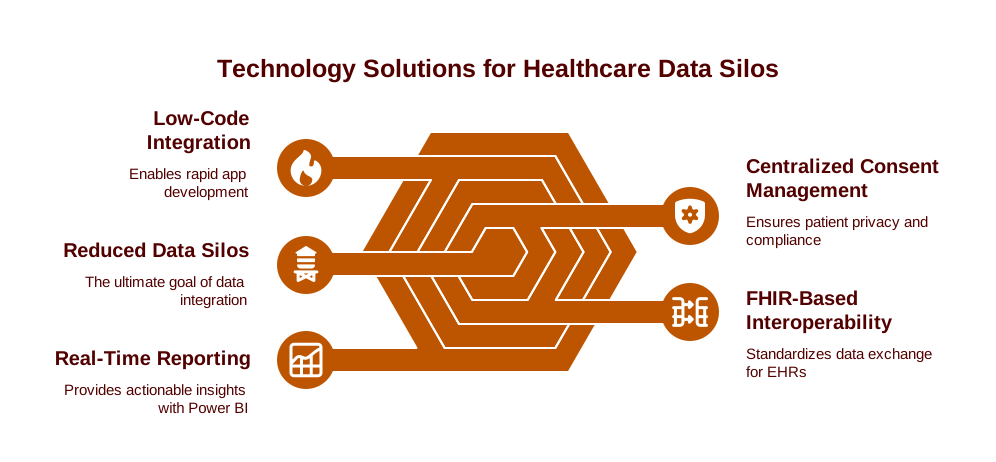
Low-Code Integration Using Microsoft Power Platform
Healthcare organizations increasingly leverage Microsoft Power Platform to connect disconnected systems without extensive coding. This platform enables IT departments to develop healthcare applications rapidly through low-code/no-code solutions. Healthcare Data Solutions for Power Platform accelerates development by providing reusable healthcare-focused tools that improve standardization across solutions. Frontline healthcare staff can function as “citizen developers,” creating custom workflows without writing code—decentralizing innovation while ensuring solutions address real clinical needs.
FHIR-Based Interoperability for EHR Systems
Fast Healthcare Interoperability Resources (FHIR) standardizes electronic healthcare information exchange. As the foundation for modern health data interoperability, FHIR defines resources—building blocks representing common healthcare concepts like patients, observations, and practitioners. In 2018, six major technology companies including Microsoft, IBM, Amazon, and Google pledged to remove barriers for healthcare interoperability, explicitly mentioning FHIR. The standard enables developers to create browser applications that access clinical data regardless of underlying health systems.
Centralized Consent Management for Patient Data Access
Effective consent management systems maintain both current and historical patient consent records for audit and compliance purposes. Modern platforms offer granular consent levels, allowing patients to indicate consent at various levels including organization and HIE-wide options. Such systems capture detailed audit logs for consent management, including timestamps, types, and sources. Centralized approaches prevent scattered settings across multiple platforms, embedding privacy into the core data flow.
Real-Time Reporting with Power BI Dashboards
Power BI transforms healthcare data into actionable insights through interactive dashboards. These tools empower clinical decision-making with fast, easy access to secure health data. Healthcare generates approximately 30% of the world’s data volume, making visualization critical for understanding patterns. Power BI connects to various healthcare systems including EHRs like Epic and Cerner, bringing data from disparate sources into unified views. This integration enables clinicians to make faster decisions by analyzing clinical activities, supplies, and outcomes in real time.
Steps to Transition to a Unified Data Ecosystem
Implementing a unified data ecosystem requires a methodical approach that addresses both technical infrastructure and organizational culture. By following a structured process, healthcare organizations can effectively eliminate data silos that hamper operations.
Infrastructure Assessment and Silo Discovery
Initially, organizations must conduct a comprehensive data asset inventory to identify existing silos. This discovery phase should document all data sources—from EHR systems to patient management platforms—to understand where critical information resides and how it flows. During this assessment, high-value integration opportunities should be prioritized based on clinical and business impact. Healthcare teams often find that fragmented workflows and computational inefficiencies delay delivery of critical insights across departments.
Workflow Mapping Across Departments
Following infrastructure assessment, process mapping (PM) becomes essential for understanding complex systems. This visual representation shows steps involved in a process from start to finish, helping teams identify inefficiencies. PM should involve representatives from different roles, as 68.2% of data entry errors occur during peak admission shifts. Multi-disciplinary meetings, direct observations, and analysis of electronic health records can inform this process. Studies confirm that teams gain a more realistic understanding of current practice through workflow mapping.
Custom Automation Design and Deployment
Based on workflow analysis, custom automations can streamline data exchange. Low-code/no-code solutions allow staff to create custom workflows without extensive coding. The goal is transitioning from multi-tool, manually orchestrated workflows to unified platforms where data engineering, transformation, and analytics occur in one place. Organizations should primarily focus on developing governed pipelines and reusable logic that every application inherits.
Staff Training and Change Management
In essence, the success of any data integration effort depends on effective change management. Studies show that 97% of executives report silos lead to negative business impacts. Healthcare organizations must prepare staff through comprehensive training specifically designed for different roles. This should include opportunities to use new systems in simulated environments before full implementation. Continuous monitoring throughout the change lifecycle helps track adoption and proficiency levels.
Conclusion
Healthcare data silos are a critical, often underestimated issue affecting hospitals and healthcare systems of all sizes. These disconnected systems quietly erode operational efficiency, inflate administrative costs, and expose organizations to significant compliance risks. Beyond the numbers—millions in preventable loss each year—silos contribute to delayed patient care, clinician burnout, and missed revenue opportunities.
As digital transformation accelerates across the healthcare sector, continuing to rely on fragmented infrastructure is no longer viable. The ability to connect systems, standardize workflows, and access real-time data is now foundational—not optional—for maintaining regulatory readiness and delivering high-quality care.
Modern integration technologies such as Microsoft Power Platform, FHIR-based interoperability standards, and centralized reporting tools offer practical, scalable solutions. But successful transformation requires more than just tools—it requires cross-functional collaboration, leadership alignment, and a structured roadmap tailored to your organization’s needs.
Healthcare leaders who take a proactive approach to eliminating data silos are better positioned to reduce operational risk, improve system performance, and reallocate time and resources to where they matter most: patient outcomes and organizational growth. The opportunity—and responsibility—to modernize is clear. The next move is yours.
Is your organization facing similar challenges with disconnected systems or inefficient data workflows?
CyberMedics partners with healthcare IT and Operations teams to identify hidden inefficiencies, integrate siloed platforms, and implement low-code automation tailored to your processes. Our custom solutions are designed to reduce risk, improve system interoperability, and deliver measurable operational impact.
Schedule a consultation to assess your current systems—or speak with a solution architect about how to unify your data ecosystem.
FAQs
Q1. What are healthcare data silos and how much do they cost hospitals annually?
Healthcare data silos are disconnected information systems within hospitals that don’t communicate effectively. These silos can cost hospitals up to $2.8 million annually in inefficiencies and compliance risks.
Q2. How do data silos impact healthcare staff productivity?
Data silos force healthcare staff to toggle between multiple systems, leading to redundant data entry and manual processes. This results in staff spending 30-40% of their workday moving information between systems instead of focusing on patient care, contributing to burnout and decreased productivity.
Q3. What are some technology solutions to reduce healthcare data silos?
Some technology solutions include using Microsoft Power Platform for low-code integration, implementing FHIR-based interoperability for EHR systems, centralizing consent management for patient data access, and utilizing Power BI dashboards for real-time reporting and analysis.
Q4. How do healthcare data silos affect patient care?
Data silos can lead to delayed patient discharge due to incomplete information, increased risk of medical errors from fragmented records, and compromised patient safety. They also result in inefficient care delivery as providers struggle to access complete patient information across disconnected systems.
Q5. What steps can healthcare organizations take to transition to a unified data ecosystem?
To transition to a unified data ecosystem, healthcare organizations should conduct an infrastructure assessment to discover existing silos, map workflows across departments, design and deploy custom automations, and implement comprehensive staff training and change management programs.