
The Real Cost of Outdated Aerospace Software: Security Gaps Exposed
Software vulnerability in aerospace sectors has become alarmingly evident with recent cyber-attacks targeting critical infrastructure. The PowerDrop malware targeting the US and the data breach at defense giant Elbit highlight the urgent need for robust cybersecurity measures in the aviation industry. These incidents expose how outdated aviation software creates dangerous security gaps that malicious actors can exploit.
Legacy aerospace systems present particularly attractive targets for cybercriminals due to their distinct vulnerabilities. Many of these systems were manufactured decades ago without cybersecurity considerations, consequently lacking necessary protections against modern cyber threats. Furthermore, the introduction of internet connectivity to formerly air-gapped operational technology introduces significant risks to the safety and reliability of aviation operations.
The consequences of these software vulnerabilities extend far beyond financial losses. Cyberattacks in the aerospace industry can compromise intellectual property, disrupt critical operations, and even undermine safety measures. This article explores the real costs of outdated aerospace software, examines why legacy systems fail to meet modern compliance standards, and presents strategies for building resilient cybersecurity frameworks to protect this vital infrastructure.
Key Takeaways
Legacy aerospace systems create critical security vulnerabilities that threaten both operational safety and regulatory compliance, requiring immediate strategic intervention.
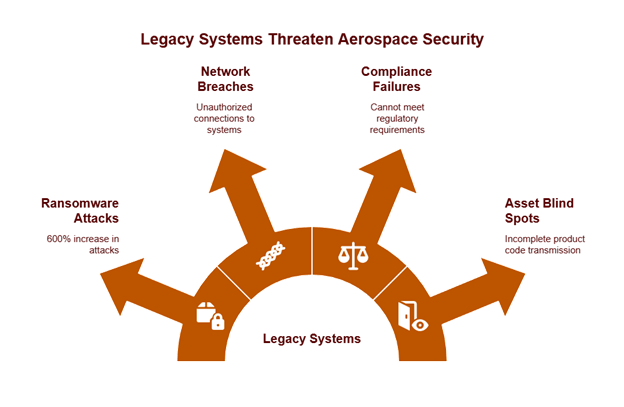
- Legacy systems face 600% increase in ransomware attacks – Aviation industry experienced dramatic surge between January 2024-April 2025, with 71% involving stolen credentials.
- Air-gapped networks aren’t truly secure – Studies found average of 11 unauthorized connections between supposedly isolated operational networks and enterprise systems.
- Compliance failures are inevitable without updates – Outdated software cannot meet AS9100 and NIS2 requirements, creating audit risks and certification threats.
- Virtual patching provides immediate protection – Organizations can secure unsupported systems without operational disruption while planning long-term modernization strategies.
- Complete asset visibility is essential – 88% of cyber-physical systems don’t transmit exact product codes, creating dangerous blind spots in security coverage.
The aerospace industry must balance operational continuity with modern security demands through targeted hardening techniques, comprehensive monitoring, and strategic governance frameworks that extend IT security practices to operational technology environments.
Legacy Aerospace Systems and Their Security Gaps
Legacy aerospace systems remain operational throughout the industry despite harboring critical security vulnerabilities. These outdated technologies create complex cybersecurity challenges that escalate rapidly into serious compliance issues.
Air-Gapped Assumptions in Legacy Design
Many aerospace organizations maintain the dangerous belief that air-gapped networks provide impenetrable security. However, this assumption has repeatedly proven false. Despite appearing isolated, these systems face numerous attack vectors:
- Physical media transfers – USB drives and other storage devices inadvertently introduce malware, as demonstrated by the Stuxnet attack on Iran’s nuclear program
- Acoustic and electromagnetic channels – Sophisticated attacks can transmit data through sound waves, LED signals, or electromagnetic radiation
- Supply chain compromises – Malicious updates or hardware components bypass air gap protections
Studies reveal that in hundreds of assessments, cybersecurity experts found an average of 11 direct connections between supposedly air-gapped operational networks and enterprise systems. In extreme cases, researchers identified up to 250 unauthorized connections.
Custom Software for Aerospace with No Update Path
Aerospace manufacturers often become trapped in vendor-controlled ecosystems with no clear upgrade pathway. These proprietary systems use custom APIs and data formats that “muscle out competition and lock clients into their ecosystem,” creating what experts term “data imprisonment”. Without vendor support, critical vulnerabilities remain unpatched—the rate of unfixed industrial control system flaws rose dramatically from 13% to approximately 34% in the first half of 2023.
Integration Challenges with Modern OT Tools
Modern cybersecurity tools struggle to interface with legacy aerospace systems, creating significant security gaps. According to 2024 research, 46% of airports cite “integration challenges with legacy systems” as a major obstacle to implementing necessary security measures. Additionally, these systems typically lack robust security features like multi-factor authentication or encrypted backups.
The integration difficulties stem from outdated communication protocols that require substantial architectural modifications. Between January 2024 and April 2025, the aviation industry experienced a 600% increase in ransomware attacks, with 27 major incidents linked to 22 different attack groups. Moreover, 71% of these breaches involved stolen credentials or unauthorized access.
Why Outdated Software Fails Modern Compliance
Outdated aerospace software creates substantial compliance liabilities that threaten certification status and operational approvals. These systems face increasingly stringent regulatory requirements while simultaneously lacking fundamental capabilities needed to satisfy modern standards.
AS9100 Clause 8.5.1 and Software Control
AS9100 certification requires rigorous control over production software, specifically under Clause 8.5.1 which mandates structured processes for operational risk management. Legacy aerospace systems fundamentally struggle with these requirements, creating direct standard violations. The clause requires “assignment of responsibilities for operational risk management” along with “definition of risk assessment criteria” – capabilities that rigid mainframe architectures typically cannot provide.
Additionally, outdated tools violate the essential traceability requirements specified in Clause 8.5.2, which includes five specific mandates for identification and configuration management. Legacy systems generally cannot handle crucial aspects like bill of materials traceability or comprehensive audit trails. These limitations directly impact productivity, with 48% of workers wasting three hours or more daily due to inefficient systems, costing businesses at least $37,000 annually in lost productivity.
Failure to Meet NIS2 Cybersecurity Baselines
The Network and Information Security (NIS2) directive establishes essential cybersecurity baselines that legacy aerospace software cannot satisfy. NIS2 categorizes aviation as an “essential service” requiring robust protections across multiple domains. Specifically, aviation organizations must implement sophisticated risk analysis systems, information system security incident handling, supply chain security measures, and multi-factor authentication.
Outdated aerospace software typically lacks these mandated security features. Between January 2024 and April 2025, the aviation industry experienced a 600% increase in ransomware attacks – with 71% involving stolen credentials or unauthorized access. These vulnerabilities exist primarily because legacy tools lack modern authentication mechanisms and encrypted backups.
Audit Failures Due to Unsupported Software
Unsupported aerospace systems create substantial audit risks. The Federal Aviation Administration identified that 37% of its 138 systems were unsustainable, with 29 unsustainable systems having critical operational impacts on safety and efficiency. These systems force organizations into risky manual workarounds that ultimately undermine audit readiness, creating processes that are “not only inefficient and time-consuming but also prone to human error”.
Notably, even aviation bodies struggle with this problem. The FAA has 17 especially concerning systems that won’t be modernized for at least 6 years, with some requiring 10-13 years for complete updates. This creates a compliance environment where both private enterprises and regulatory bodies fall short of modern requirements.
Bridging the Gap: From Legacy to Secure Systems
Modernizing legacy aerospace systems requires strategic approaches rather than complete replacements. With 44% of mission-critical components approaching or having reached their end of life, organizations must implement targeted security measures to bridge critical gaps.
Software Vulnerability Analysis in Legacy Code
Effective vulnerability analysis in aerospace legacy code demands specialized techniques, as these systems were originally designed for functionality rather than security. Goal-driven decompilation represents a breakthrough approach, using existing source code samples and knowledge of the original build process to improve analysis and direct it toward specific security objectives. Subsequently, this enables engineers to translate knowledge of flaws from source code to binary format, accelerating identification and repair of vulnerabilities.
Virtual Patching for Unsupported Systems
Virtual patching provides immediate protection for systems that cannot be traditionally updated. Unlike regular patching which alters system code, virtual patches intercept exploit attempts at the network or application level. This approach offers several advantages:
- Provides scalable protection implemented in few locations rather than installing patches on all hosts
- Reduces exposure without operational disruption
- Enables protection for mission-critical systems that cannot be taken offline
- Helps meet regulatory mandates even before permanent fixes can be applied
Virtual patching has proven particularly valuable in aerospace environments where vendor support has ended or where systems cannot be safely rebooted.
CyberMedics Approach to Legacy System Hardening
Legacy aerospace systems harbor critical security vulnerabilities that directly threaten regulatory compliance. CyberMedics applies specialized hardening techniques to address these risks without complete system replacement. This methodology focuses on identifying and mitigating integration barriers caused by outdated communication protocols.
Extending IT Governance to OT Environments
Maintaining an up-to-date asset inventory forms the foundation for effective OT governance. Furthermore, comprehensive vulnerability scanning must be strategically scheduled during planned downtime and utilize non-intrusive tools specifically tailored for operational technology. Accordingly, patch management requires thorough testing in staging environments to ensure compatibility with legacy systems and maintain operational continuity.
Building a Resilient Aerospace Cybersecurity Framework
Establishing cybersecurity resilience in aerospace demands a comprehensive approach that addresses the unique challenges of cyber-physical systems (CPS). First and foremost, organizations must implement structured frameworks that provide visibility, monitoring, response capabilities, and supply chain protection.
Full CPS Visibility with Asset Discovery Tools
Effective protection begins with complete visibility into all connected assets. Research shows 88% of CPS assets currently do not transmit exact product codes, while 76% transmit product names that differ from official vendor records. This creates dangerous blind spots in security coverage. Modern discovery solutions use passive monitoring techniques to identify assets without disrupting critical operations, essential in environments where systems cannot be taken offline for scanning.
Threat Monitoring and SIEM Integration
Continuous monitoring powered by anomaly detection and behavioral analytics enables early identification of deviations from normal operations. AI-enhanced security information and event management (SIEM) solutions can detect unusual activities that might indicate compromises. Meanwhile, organizations benefit from extending their IT security tools to operational technology environments rather than maintaining completely separate systems.
Incident Response Planning for Legacy Systems
Aviation organizations must develop explicit incident response procedures for legacy systems. This includes establishing backup methods like the paper-based processes that proved critical during recent system outages. Regular testing through tabletop exercises ensures teams can respond effectively under pressure.
Supply Chain Risk Management in Aerospace
Supply chain vulnerabilities present significant exposure given the complex ecosystem of aerospace manufacturers, suppliers and service providers. Effective management includes conducting thorough due diligence, implementing stringent cybersecurity requirements, and maintaining ongoing monitoring of third-party security practices.
Conclusion
Outdated aerospace software continues to pose substantial risks across the aviation industry. Throughout this article, we have examined how legacy systems create dangerous security vulnerabilities that malicious actors actively exploit. Certainly, the sharp rise in ransomware attacks—increasing 600% between January 2024 and April 2025—underscores the severity of this threat landscape.
Legacy aerospace systems face multiple security challenges. Air-gapped assumptions repeatedly prove dangerous, while vendor lock-in prevents critical security updates. Additionally, these outdated systems struggle to meet modern compliance requirements such as AS9100 and NIS2, leading to audit failures and operational risks.
Organizations must adopt strategic approaches rather than complete system replacements. Virtual patching offers immediate protection for systems that cannot undergo traditional updates. Similarly, goal-driven decompilation enables better vulnerability analysis in legacy code. Meanwhile, extending IT governance to operational technology environments helps establish consistent security practices across all systems.
Building true resilience demands comprehensive frameworks addressing the unique challenges of cyber-physical systems. This includes implementing robust asset discovery, threat monitoring, incident response planning, and supply chain risk management. Though significant challenges remain, targeted security measures can bridge critical gaps while organizations develop long-term modernization strategies.
The stakes remain extraordinarily high. Beyond financial consequences, cyberattacks can compromise intellectual property, disrupt critical operations, and potentially undermine passenger safety. Therefore, aerospace organizations must prioritize cybersecurity investments, recognizing that protecting legacy systems requires specialized approaches different from conventional IT security. The industry’s future depends on successfully balancing operational requirements with modern security demands, ultimately ensuring both system integrity and public trust.